
Collective and Individual Political Education
As a small but growing collective of revolutionary socialists in eastern Massachusetts, the tasks set out for us can seem daunting: we need to grow numerically so that we can intervene more decisively in the movements that capitalism inevitably creates by exploiting and oppressing the overwhelming majority of people, but we also need to grow politically, so that our interventions are based in a set of ideas that can help movements grow and move toward their goals, without falling into the traps of either ultra-leftism (i.e. sitting out when movements “aren’t radical enough”) on one hand, or opportunism (i.e. hiding or changing our politics so that the more liberal factions of the movements we work in don’t see us as a threat, even when we have serious disagreements with their tactics) on the other.
The approach we take to both of these problems revolves around a fundamental fact: if we don’t understand the world around us, or don’t have the political ideas necessary to explain the world to other people coming to revolutionary conclusions, we can’t grow on the basis of real political agreement between our membership, and we’ll go out into movements with ideas that are confused, contradictory, or just plain wrong. At best, this can make us seem like disconnected outsiders. At worst, we can accidentally introduce ideas that drive movements into the arms of the Democratic Party, where social movements have historically gone to meet rather undignified ends.
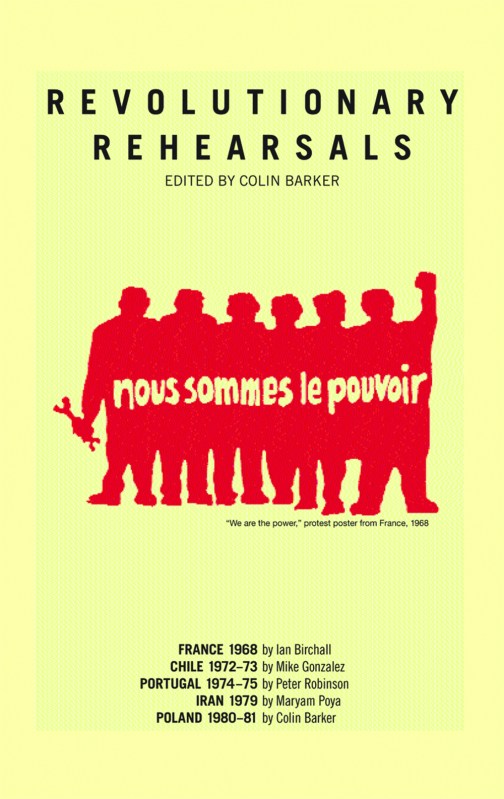
For this reason, we place a very high priority on political education, both collectively and individually. For the past few months, we’ve been reading and discussing chapters from a book called Revolutionary Rehearsals, published originally by Bookmarks in 1987, with a new printing in 2002 from Haymarket Books.
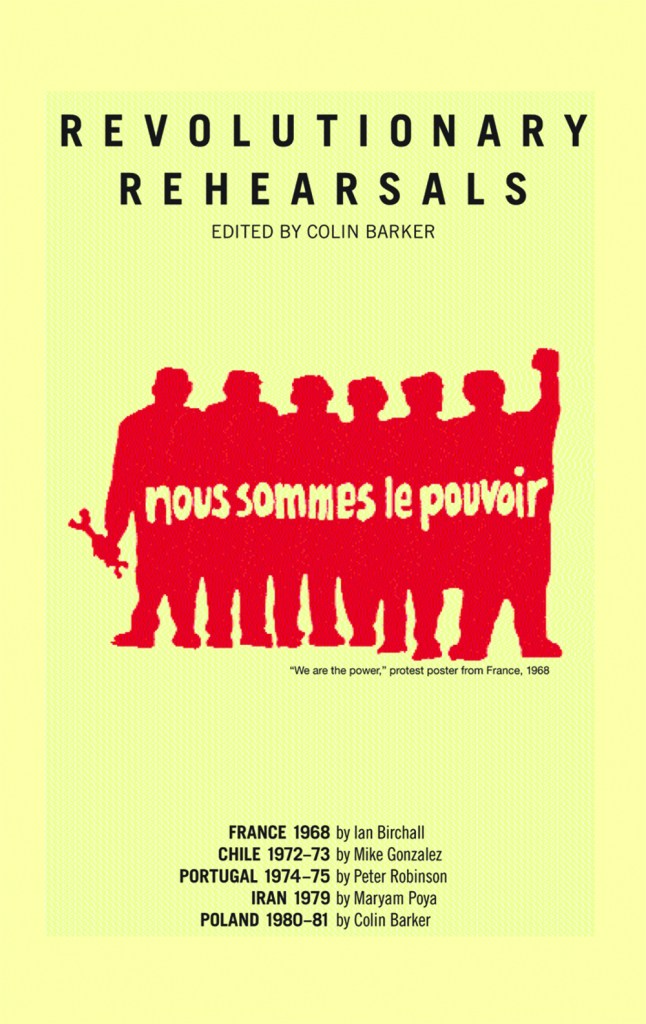
Revolutionary Rehearsals, when originally published in 1987, posed a compelling argument: that revolutions were not rare historical phenomena that required extraordinary conditions to occur; rather, they were quite common, and an inevitable result of the pressure that the capitalist system places on working people. Revolutions that win, however, are rarer. Revolutions are the inevitable result of an exploitative and oppressive world-system, in which people are unwilling to be ruled any longer by a ruling class that has lost the control over them that they’ve come to take for granted.
But revolutions, as rapid and explosive as they may be, are not automatic processes, and can’t happen without the intervention of huge swaths of society, spurred into motion. If a revolutionary process is interrupted, or reaches a critical turning point and is unsure of how to move forward, the ruling class which had been initially caught on the back-foot can regain its resolve and momentum, crushing this revolutionary hope with a violent reactionary wrath that would make history’s most notorious tyrants tremble.
Revolutionary Rehearsals is a collection of essays about these very situations, in which revolutionary conditions arose, but were not able to complete the working classes’ historic mission of taking state power into the hands of the proletariat, defeating the capitalist class, and sweeping class society into the ash-heap of history forever.
Thus far, we’ve read the first two chapters: France 1968 and Chile 1972-1973. Below, I’ve included excerpts from our terrific discussions on these opening chapters.
France, 1968: All Power to the Imagination!
In 1968, it seemed like France was, in a sense, ‘Winning’ the capitalism of post-WWII Europe. In the 50’s and 60’s, the recovery that happened after the collapse of the Fourth Republic during the Algerian War, led by Charles De Gaulle in the seat of a strengthened Presidency, was making major progress in modernizing the French economy, and delivering huge benefits – for the bosses. By focusing on growing higher education, and training a layer of skilled workers (engineers, technicians, and managers), France was able to create an enormous sub-class of students, and build a modern capitalist state compared to much of the rest of Europe, and the bourgeoisie won big. Workers, on the other hand, faced decades of stagnant class struggle, hampered by apathetic unions, and an official Communist Party preoccupied with electoral victory and participation in Parliament.
Despite these ostensible gains, workers never stopped fighting. In fact, signs of real struggle stayed slowly simmering, just under the surface: 1963 saw a two-and-a-half month long miners’ strike. 1965 saw surprising electoral results for Socialist Francois Mitterand, which indicated, if nothing else, people’s impatience with high unemployment and stagnating wage growth. And in 1967, a wave of smaller strikes and lock-outs across engineers, auto-workers, the steel industry, the ship-building industry, and over eighty labor actions at the Renault Billncourt plant alone, indicate a growing restlessness amongst the French working class.
Then, in May of 1968, with increasing police repression of demonstrations against the Vietnam War, history took a detour through a growing section of society: French Students. In a matter of weeks, the stable growth of the post-war period was turned on its head, and over 9 million people had participated in one of the largest general strikes in history.
Chile, 1972 – 1973: The Workers United
Salvador Allende is elected in December 1970. He is a member of the Socialist Party, which is a member of the UP (Popular Unity) coalition, along with Communist Party, Radical Party, Popular Unitary Action Movement (MAPU), and Christian Left. These groups, along with the working class, supported Allende’s election. The goal of the party was to unite the working class, the government and the military, and nationalize large sectors of the economy. Almost immediately, once in office, Allende concedes to the ruling class by way of a “statue of guarantees” that is undeclared to the public, and represented an agreement between Allende and the congress. The author argues that the goal of this document was essentially to limit the impact the UP could have on its control of the ruling class.
By the time Allende is elected – and only by 36% of the popular vote – the workers had already been on the ground for years increasing their activity by way of strikes. The author writes:
‘Many sectors of the workers and peasants saw no reason why Allende’s arrival in the presidential palace should involve their demobilization‘
For the first few months, things are pretty good all around. Union workers saw wage increases, unemployment was down and GDP was up. A few industries were nationalized and Allende pretends to try to move forward with his predecessor’s plan to share the wealth of land with the landless in order to appease the peasants who had flocked to various areas awaiting their pay out of a land parcel to the tune of nearly 1300 ‘land invasions’.
More money means access to more stuff, which meant, allegedly, less stuff to go around – and the ruling class pretty immediately uses this as a reason to protest the government. Of course, they are themselves responsible for the shortages, having both hoarded, exported and ceased investment in their own economy in reaction to the UP and Allende…and the workers organizing.
Individual Reading
Aside from our discussions about Revolutionary Rehearsals, I asked my comrades: “What else are you reading?” These are some of the responses I received:

“Recently, I’ve been reading Capital, Vol 2. by Karl Marx – you all may have heard of him. It’s the follow-up to the much debated (but less-read) first volume of his magnum opus about the capitalist system, in which Karl Marx describes how the circulation of capital through trade operates in relation to the system of production described in the first book, which is ultimately based on the exploitation of the working class for profit.”
“I am reading two books simultaneously at the moment, and pretty much always these days because there’s so much to read! Russian Women’s Studies is a book by Tatyana Mamonova that includes essays on sexism in Soviet culture, ranging from history to art and science to current day (written in the 80s) solidarity after the Cold War.


“I’m also reading The Communist Manifesto: A Roadmap to History’s Most Important Political Document, edited by Phil Gasper. The format is such that he annotates each paragraph with historical references and puts Marx and Engels’ words into language that is easier to grasp. especially for first-time readers.”
“Current Read: Palestine, Israel and the US Empire, by Richard Becker.
“It’s about the connection between Israel and US imperialism. A detailed history of Palestine and the Middle East dating back to 1882 from an anti-Zionist perspective”


“I’m reading White Trash: The 400 Year Untold History of Class in America by Nancy Isenberg.
“I really like it and think it should be a required read for middle school. I had to get used to the way the author writes about people and remind myself that she is reflecting the language and attitude of the times of which she is writing. And I’m also not that far in either – maybe a hundred or so pages.“
“Current reading: Imperialism and the World Economy by Nikolai Bukharin.
“When Lenin wrote Imperialism: The Highest Stage of Capitalism, he wrote it as a more easily digestible summary of fellow Bolshevik Nikolai Bukharin’s much longer book. In “Imperialism and the World Economy,” Bukharin does a much more thorough job looking at the bigger economic tendencies of modern capitalism and how they have created imperialism. The book includes topics like state policy, migration and international finance; how these and other issues connect together under one system; and how the normal operation of that system drives every country towards monopoly and war.”

If you’d like to read Revolutionary Rehearsals with us, the next chapter we’re discussing will be about Portugal in 1974; we’d love to have you in our discussion, which is currently scheduled for Sunday August 30th. Head over to our Contact Page and drop us a line, and we’d be glad to get you in the loop!
 Boston Revolutionary Socialists